domingo, 3 de abril de 2011

Summary of International Trade

Summary of International Trade


In analyzing the economy, we review the dimension that transcends the borders of a country, ie, addressing the economic problems for international purposes.The importance of international relations in the sphere of trade, politics or culture has reached a global level, a deeper meaning to such an extent that one can not speak only of goods but also trade integration schemes.

Is exchange of capital, goods, and services across international borders or territories. In most countries, it represents a significant share of gross domestic product (GDP). While international trade has been present throughout much of history, its economic, social, and political importance has been on the rise in recent centuries.
The international economy poses to study the problems of international economic transactions, therefore when we talk about international economic co link international trade factors.International trade is the exchange of economic goods that takes place between the inhabitants of two or more nations, in such a way that gives rise to outflows of goods from one country (export) entries of goods (imports) from other countries.The data show a definite statistical link between freer trade and economic growth.Economic theory points to compelling reasons for the link. All countries, including the poorest, have assets-human, industrial, natural and financial, which can be used to produce goods and services for their domestic markets or to compete overseas.Economics tells us that we can benefit when these goods and services are traded.Put simply, the principle of "comparative advantage" says that countries prosper first by taking advantage of their assets to concentrate on what they can produce best, and then exchanging these products for products that other countries produce best.
Causes of International TradeInternational trade is due to two causes:
-Distribution of economic resources-Price difference, which in turn is due to the possibility of producing goods in accordance with the needs and tastes.

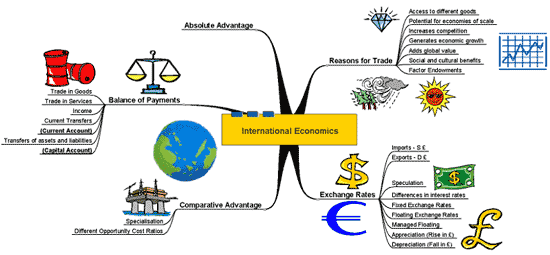
The mind map

The mind map


International economics is concerned with the effects upon economic activity of international differences in productive resources and consumer preferences and the institutions that affect them. It seeks to explain the patterns and consequences of transactions and interactions between the inhabitants of different countries, including trade, investment and migration.economies of scale are benefits from bulk buying:


International monetary economics and macroeconomics: studies money and macro flows across countries.


International trade: which covers all transactions made ​​between individuals belonging to different States. Because that country produces only that for which it is most ready and the rest is obtained from other countries sharing their surplus with them. studies goods-and-services flows across international boundaries from supply-and-demand factors, economic integration, and policy variables such as tariff rates and trade quotas.


International finance is an area of knowledge that combines elements of corporate finance and international economics. Finance is the study of cash flows. Study international finance cash flows across national borders. International financial management is the process of making decisions about cash flows presented in the context of multinational enterpris

Exercise week 2 - Describe 3 products of the bank

Exerc Describe 3 products of the bank


The credit card is a plastic card with a magnetic strip, a microchip and a number in relief. It is issued by a bank or financial institution that authorizes the person to whom it is issued, using it as payment in business attached to the system, by signing and displaying the card.Among the best known of the market are: Visa, American Express, MasterCard, Diners Club, JCB, Discover, among others. Large stores and warehouses of the world also issue credit cards to its customers.Users have limits on the amount they can charge, but is not required to pay the full amount each month. Instead, the balance (or "revolving") accrues interest. You can make only a minimum payment and pay interest on the outstanding balance. If you pay in full, no interest is paid.The biggest advantage is the flexibility it gives the user, who can pay their balances in full on your monthly due date or pay a part. The board sets the minimum payment and finance charges determined for the outstanding balance. Credit cards can also be used at ATMs or use a bank for a cash advance but, unlike debit cards, interest is charged by the provision, commission and, in some countries, a tax because it is a loan.

A check (anglicized check or check) is a valuable document in which the person is authorized to withdraw money from an account (for example, the owner), extends to another person an authorization to withdraw a certain amount of money their own, without the presence of bank account holder.Legally, the check is a security to order or bearer form and abstract by which a person, called the drawer, ordered unconditionally to a lender that is delivered, the payment on demand of a sum of money for a third person named beneficiary.


An appropriation is the transfer of possession of goods of its owner, called the Client or consignor, another person, called the broker or consignee, who becomes an agent of that for the purposes of selling goods. The provision is a surrender in trust, and relationships established between the consignor and consignee that correspond to the commercial law are studied as a deposit and agency.

Financie Glossary


  • Current assets: set of accounts of a company's assets that anticipate its conversion into cash within less than a year. They are usually constituted by box and banks, accounts receivable, inventories, etc.
  • Fixed assets: permanent assets that are typically required for carrying out the usual turn of a company. They are usually constituted by machinery, equipment, buildings, land, etc.
  • Financial assets: assets that generate financial returns.
  • Intangible assets: intangible, type such as patent assets.
  • Ad valóren: tariff established as a percentage of the value of the invoice for the goods.
  • Depreciation: Partial or full payment of the principal of a loan.
  • Linear depreciation: depreciation in which each method is deducted a fixed amount of the obligation.
  • Regression analysis: statistical method for estimating the behavior of a variable based on the record of other variables.
  • Sensitivity analysis: simulations of scenarios through which seeks to observe the changes in the model results based on variations of your main variables.
  • Anti-dumping: Legal action to protect domestic markets from unfair competition from abroad, for the use of prices that do not cover production costs.
  • Annuity: Stream regular funds and the same amount during a certain number of periods.
  • Financial leverage: Ratio of total debt to total assets. Proportion of the total assets has been financed with loans.
  • Exchange rate appreciation: movement toward the low exchange rate expressed as a number of national currency per unit of foreign currency.Also known as exchange rate revaluation.
  • Tariff: Tariff of tax that a tax on the import or export of goods and services.
  • Arbitration: Process by which can be very short term gains for the simultaneous existence of different prices for the same product, in the same or in different markets.

TYPES OF INVESTMENT


TYPES OF INVESTMENT


There are many types of investments. Mainly classified into four types of assets:
1. Property 2. Short Term Deposits 3. Actions 4. Bonds 


Each form of investment assets that implies different caters to different types of risk, return, liquidity, maturity and duration.

Brief description of different types of investment:
- Short-term deposits, bank savings account is the simplest form of short-term investment. One of the main advantages of this investment is that avows provider 100% guarantee of profitability. However, the returns offered are low compared with other investments, but there is no possibility of a fall in the value of the investment as well as other types of investments.
A short-term deposit offers full liquidity. Means all investors can withdraw money when needed. Perfect choice for short-term savings or emergency funds.
However, there is an option for medium to long-term deposits.
Bank Fixed Term Investment: The total amount of money deposited for a period usually six or twelve months away is blocked by the bank for a specified period. Here, investors get higher interest than a savings account straight. Depending on interest rates, investment is the best option for the short or medium term.
- Bonds: Basically, it is considered as IOU issued by a company or government.Investors invest money in bonds for some time to get back at an interest rate. For a fixed term, bond investors immediate blocking of the money. However, at times, investors can withdraw the money deposited for commercial purpose.
Generally, a bond is not an ideal option for short-term investment. Instead of bonds, small investors are supposed to managed funds. It would be good for small investors do not invest directly in bonds.
- Property: It is safe and profitable to invest in a property. It is beneficial for long-term goals. What's more, the investment without the knowledge and skilled care may suffer considerably.
On the other hand, losses on real estate investments are not published. Before investing in any property, investors need to understand and manage the various issues and aspects of real estate investment.
There are two types of investment property: the direct and indirect property investments.
Property Direct Investment: The investors have to manage the daily administration, such as finding tenants, bond and rent collection and care of maintenance problems.Or, go through the property management company to pay for these services.
Indirect Property Investment: The investors have options to invest, whether managed in mutual funds or retirement plan. Here investors purchase property without actually finding the property and doing the hands on management. It offers diversification benefits for the average investor.
- Actions: Investors are viable for legal fees and the value of the company through investment in publicly traded companies. Investors can assess return through dividends and capital gains. Through actions, investors can invest in a wide range of companies operating in different regions and may benefit from long-term gains.


CAUSES OF INFLATION


CAUSES OF INFLATION


The increases have been generated by different factors, but principally by the late winter of last year and the rainy season began in mid-February to register this year, and could be extended until June.
The increases occurred despite the adjustment of gasoline prices took effect in March.

Between March 2010 and February 2011, ie the last twelve months, the IPC showed a variation of 3.17%. The groups of goods and services that further increase occurred in the first month of the year were education (4.17%), food (0.66%) and health (0.60%). By contrast, those who had less variation in the month of January were fun (-0.14), apparel (-0.10%) and communications (0.04%).

  • The demand-pull inflation: Inflation occurs when aggregate demand increases more rapidly than reduction. This increase may have different origins: an increase in household consumption, increased public spending or spending on business investment.
  • The cost-inflation: Inflation would by increasing production cost. Maybe motivated by the rising cost of asic natural resources, or the cost borrowing or interest rate.
  • The structural-inflation: Is an existence of imperfect markets, which set prices at levels higher than those of free competition, conflict between economic agents, the existence of administered prices to project or benefit certain social sector.